The five themes of pet loss grief

A recent review of 17 studies into pet loss grief summarised by Psychology Today highlighted what most bereaved pet carers already know and that is that grief for an animal companion can be as strong as that felt when a human loved one dies. 

The research also identified five themes of pet loss grief that influence how we feel: The relationship, the grief, the guilt, the support network and the future.

But what is meant by these?

  1. Your relationship or bond with your pet

The research reviewed shows that pet loss grief is shaped by the relationship and bond you shared with your pet.

Our animal companions see us in our most relaxed, unguarded and vulnerable moments, sharing our homes and everyday routines. In many ways, they know more about us than anyone, maybe even the other humans we live with.

Animals offer us unconditional love, even when we’re going through a rough patch in life. They give us companionship, support and even independence, in some cases.

In turn, many of us enjoy our role as a caregiver to our pets, finding happiness in nurturing another living being. 

Is it any wonder that we grieve for that loving and accepting presence in our lives when they’ve gone? 

As with any relationship in life, it’s clear that deep bonds can lead to a period of deep grief.

  1. How you feel and express your pet loss grief

Grieving pet carers consistently report experiencing psychological and physical symptoms of grief, such as feelings of emptiness, loss of appetite, sleep disruption and more.

However, other factors may affect pet loss grief too. This includes your other caring responsibilities (e.g. other non-human animals, young children, ageing parents), previous experiences with pet loss and bereavement or, for some people, the type of animal that has died.

In the absence of the mourning rituals we routinely observe when a human dies, bereaved pet carers often feel that their grief isn’t recognised or taken seriously and that they have no choice but to grieve alone. They may have to create their own ways to mourn – for example, planting a memorial garden, writing a letter to their pet or displaying their belongings as a way to remember them.

The research also shows that grieving pet carers adopt a wide range of coping mechanisms, from keeping busy and not talking about their loss to dwelling on it for long periods of time. There may also be a lot of anxiety about whether or not to welcome a new pet into their home and if this is trying to “replace” the pet who has died.

  1. Feelings of guilt

Something that comes up time and again is how guilty we feel when a pet dies, regardless of the circumstances.

There are several clear reasons for this. 

Animals are unable to verbally express their wishes to us so, as pet carers, we have to act in what we believe to be their best interests. But how can we be sure? What would an animal want if they could tell us? This is something many of us grapple with.

Our animal companions are dependent on us for everything – from the food they eat to where they sleep, how they spend their time and so much more. In many ways, this means they are as vulnerable as a human infant. Knowing this can make us fiercely protective of our animal friends and is a huge responsibility.

It’s within this context that euthanasia represents both a gift and a curse. We talk about euthanasia as the last kindness that we can show to an animal who is dying. The word itself comes from the Greek meaning “good death” and most would agree that it’s a valid choice to end an animal’s suffering. 

But it’s a decision that weighs heavy on us as pet carers. Knowing that euthanasia is an option gives us the power of choosing life or death for our non-human family members, even if it’s just bringing death forward when it has become inevitable, and that can be difficult to reconcile when your entire relationship has been about helping your pet to thrive.

What if we chose euthanasia too late? What if it was too soon? What if it was the wrong choice? Was there another option?

It’s common for pet carers to wrestle with these thoughts for some time after their pet has died, even when we know that we made the choice in order to end our friend’s suffering. Guilt is usually tied to these thoughts.

It’s also not unusual for bereaved pet carers to worry that they betrayed their pet in some way by choosing euthanasia. It can take a while to make peace with the decision.

  1. Whether you have a good support network

Although we all experience grief differently, the research shows that people benefit from having a good support network around them.

As we’ve already mentioned, one of the challenges of pet loss is finding people who are understanding and willing to listen. Pet loss is often described as disenfranchised grief because it isn’t always recognised within our wider society or personal networks.

Research from 2019 found that disenfranchised grief in pet carers can directly increase the severity of the grief and inhibit post-traumatic growth, which is a kind of positive psychological change that comes after a loss for some people because they develop a  greater appreciation of life, value their relationships more and view the world with more compassion.

People who haven’t experienced pet loss may struggle to understand your connection with your pet or they may see pets as property that can simply be replaced. Similarly, many people without pets assume that, because animals generally have much shorter life spans than humans, we go into having a pet with our eyes open, knowing that we’ll lose them someday – the assumption being that, because we know it’s coming, it hurts less.

All of the above assumptions are clearly wrong.

It’s so important for bereaved pet carers to be able to access support in order to validate their feelings. This might mean talking to a sympathetic friend, speaking to a pet bereavement counsellor or joining a support group like the private Ralph Site support group on Facebook.

Research from 2005 found that people in pet loss support groups directly benefited from being able to talk about and process their loss without embarrassment or the stigma society can still place on grieving for an animal.

Pet loss research also offers a reminder to vets that it is important for them to communicate clearly and with compassion and, even after the event, to be willing to talk through any decisions that were made around a pet’s care to help the pet carer understand what happened as fully as possible.

  1. How we see the future

Moving forward after pet loss can take time.

Some bereaved pet carers process their loss with a new appreciation for how short and precious life is. Others find themselves frozen in grief for much longer than they might have expected.

Inevitably, the question comes up of if or when to offer a home to another pet. For some people, it isn’t a choice – for example, if they need an assistance dog to live independently – but this can still lead to feelings of guilt or of it being “too soon”.

Some people find that their pet has left such a big hole in their life that a new pet is the only way to fill it. This isn’t always straight forward though as the pet carer worries that they’re trying to replace their loved one or that they’re forgetting them (not that this is true in any way).

Others struggle to imagine ever welcoming a pet into their lives again and this can cause a huge shift in identity and sense of purpose.

The future can be particularly daunting if your daily routines or social life revolved around your pet. 

Confirming what we already knew about pet loss grief

The growing body of research into pet loss grief really just serves to reinforce what bereaved pet carers already know – that the pain of pet loss is valid, real and an inevitable part of losing someone we love.

Society often views pet loss grief as an over-reaction or a substitute for other types of grief (for example, research by Liz Margolies in 1999 suggested that women become ‘hyperattached’ to pets 

It’s clear that pet loss presents some unique challenges, especially in terms of coping with guilt or finding support.

Hopefully, this recent review of the available research will remind counsellors, GPs, psychologists or social workers (or, indeed, anyone who knows a bereaved pet carer) that they have a vital role to play in helping the person to cope with their loss.

If you do need support or would like to talk about your pet loss grief, The Ralph Site pet loss support group on Facebook is there for you.

You are not alone.

Very best wishes from Shailen and The Ralph Site team
The Ralph Site, non-profit pet loss support

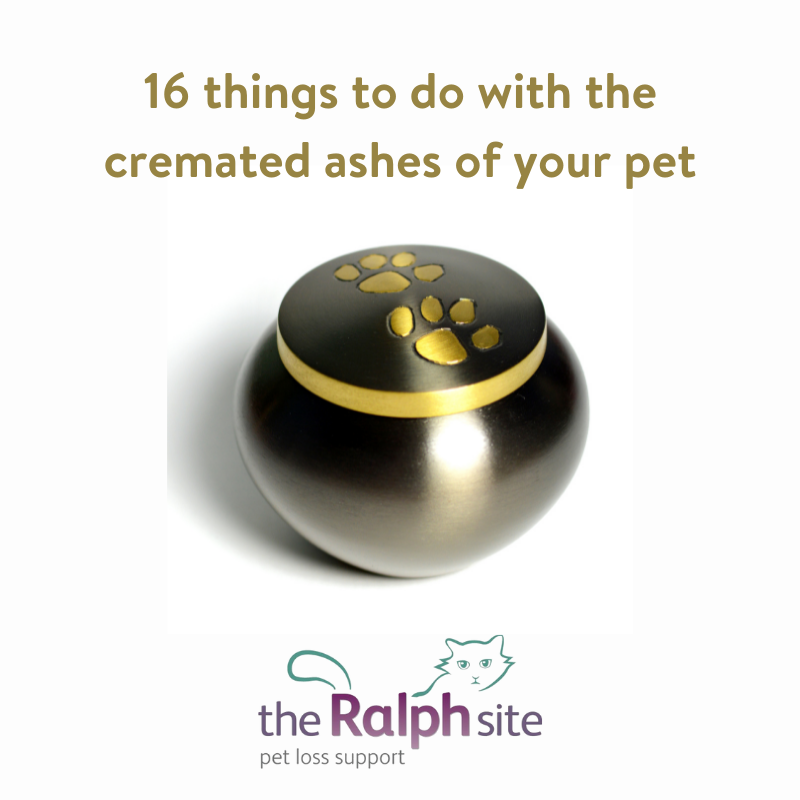
16 things to do with the cremated ashes of your pet

Saying goodbye to a beloved pet is never easy. On a practical front, something that many of us wrestle with is the question of what to do with our pet’s ashes (sometimes referred to as “cremains”). Some people have strong feelings about wanting to keep their loved one’s ashes at home while others prefer to lay them to rest somewhere.

If you don’t feel comfortable about receiving your pet’s ashes, speak to the pet crematorium where your pet is being cremated as they will have a service where they can scatter the ashes on your behalf (usually in an unmarked woodland or similar area). You should still be able to ask for a Certificate of Cremation.

As with all things related to pet loss grief, there is no right or wrong about what to do with your pet’s ashes, only what feels right for you.

Thankfully, there are more options than ever before about what to do with the cremated ashes of your pet. Hopefully, you can find an option that feels like a fitting tribute to your lost companion. 

And remember that you don’t have to make a decision straight away – many of the ideas below can be carried out long after your pet’s ashes have been returned to you.

  1. Keep them in a decorative urn

An ever-popular option for storing cremated ashes is a decorative box or urn. These days, there are some truly beautiful urns or memorial boxes available to buy in materials such as ceramic, wood, mother-of-pearl or various metals. 

Depending on the design, you may have the option to have the urn engraved, or add a plaque or photograph of your pet. 

Urns and memorial boxes come in all shapes, styles and sizes too from rustic-style wooden urns to pristine stainless steel and everything in between. It is even possible to commission an urn that is a sculpture of your pet. 

  1. Bury the ashes

Perhaps the simplest way to memorialise your pet and lay their ashes to rest is with a garden burial. This is another popular option.

Did your pet like to lay in a sunny spot in the garden? Did they have a favourite place to explore? You could bury their ashes in this special space so that you can think of them there in happier times.

If you’re worried about the fact that you might move house one day and have to leave your pet’s ashes behind, you could have a memorial stone made that you’re able to take with you when you move.

Many people choose to plant a favourite tree, shrub or flower to mark their pet’s ashes.

Another idea is to bury your pet’s ashes within a contained plant pot so that you’re able to take them with you from home to home.

  1. Grow a memorial tree

While we’re on the subject of planting something where your pet’s ashes are buried, you might choose to grow a memorial tree.

Companies such as The Living Urn offer biodegradable bamboo urns that contain a tree seedling and will hold an animal’s ashes. This is a wonderful way to watch a living memorial to your pet grow and flourish.

  1. Scatter the ashes

Many people choose to scatter their pet’s ashes somewhere that has meaning to them. This could be a favourite walk, a favourite place or even just somewhere that always makes you feel peaceful, such as a hilltop or your favourite beach.

In the UK, there’s no explicit law against scattering ashes, as long as you get permission from the person or organisation that owns the land. You don’t need permission to scatter ashes on your own land or over a body of water.

Regulations around scattering ashes vary around the world, so you should always check your local by-laws.

  1. Perform a water burial

As there are no laws against scattering ashes over a body of water, you may decide to give your pet’s ashes a water burial.

The best advice is to choose somewhere quiet to do this, as far away from people, buildings and fish as possible and on a day when the wind is low, especially if you plan to scatter the ashes.

You can choose to use a biodegradable water urn for your pet’s cremains. These urns usually float for a while before gently submerging into the water where they safely break down and release the ashes over time.

Another option is to hold a ceremony where you gather with your pet’s friends and family at the beach and you dig a small trench near the water’s edge into which you place the ashes (people often do this in the shape of a heart or their pet’s name). You can then watch the tide carry the ashes away.

As an alternative to laying a wreath for your pet during a water burial, you could scatter something biodegradable like rose petals as you say goodbye.

  1. Have them incorporated into a piece of jewellery

It’s now possible to have some of your pet’s ashes (or fur or feathers) incorporated into a piece of jewellery. This includes rings, necklaces, bracelets, trinkets, pendants, brooches and more.

If you have a look on a site such as Etsy, you will be amazed by some of the stunning jewellery available.

  1. Include them in a piece of decorative glass

You can also have your pet’s ashes incorporated into a piece of glass. This could be a stained-glass design such as a window or a rainbow sculpture, a heart, glass pebbles, paperweights, sculptures or candle holders.

Again, a search on Etsy for “glass for ashes” is a great starting point to explore your options.

  1. Launch them into space

Would you believe that it’s now possible to have your pet’s ashes sent into space? There are a growing number of businesses around the world offering this service to humans and/or their animal companions.

This is certainly one of the more expensive options for scattering ashes but many people like the idea of looking to the skies and knowing that their pet will always be watching over them.

  1. Have them painted into a portrait of your pet

Some artists use a process where they can incorporate ashes into the ink or paint that they use. They can then paint or draw a custom portrait of your pet that includes a small sample of their ashes.

Again, a search engine search or a creative site like Etsy would be the best starting point to find someone who offers this service.

  1. Cast them in a statue

Another creative use of pet’s ashes is where they are mixed with concrete and cast into a sculpture, pebble or heart shape, for example.

Rather than being a vessel to hold the ashes, the idea is that the ashes become part of a piece of artwork that represents your pet, either as a statue of them or in a more abstract design.

  1. Add them to a piece of pottery

Similarly, there is a small but growing number of potters who can incorporate ashes into a piece of ceramic pottery (either the clay and/or glaze). This is a way to use your pet’s ashes to create a beautiful, personalised piece that brings you joy when you look at it.

  1. Keep them in a special Christmas ornament

If you’re someone who loves to decorate their Christmas tree with ornaments that have great sentimental value (perhaps baubles your children made at school) then you might want to have some of your pet’s ashes added to a special Christmas ornament.

Again, a search for “Christmas ornaments for ashes” on Etsy or a similar site is a good place to start.

  1. Add them to an hourglass

Another popular option is to keep a precious pet’s ashes in an hourglass urn. People often choose to mix the cremains with sand from their favourite beach (a great choice to memorialise a water-mad dog!) and turn the ashes into a kind of interactive sculpture.

  1. Turn them into a diamond

A diamond using carbon extracted from the ashes and/or fur of your pet is a beautiful and heartfelt way to immortalise their cremains. The diamond will be completely unique and is grown in a laboratory to your specifications. 

Various companies offer this increasingly popular service so it’s best to start with a Google search.

  1. Get a memorial tattoo

Cremation or ritual tattoos are created by infusing a small amount of your loved one’s ashes into tattoo ink. The ink is then used in the same fashion as it would be during a regular tattoo. 

Having a tattoo made with a pet’s ashes is seen by many as a way to keep a part of your loved one with you forever.

  1. Add them to a soft toy

Although it’s not a substitute for cuddling your pet, you could choose to have their ashes placed inside a memorial soft toy, such as a teddy bear, dog, cat or rabbit.

Some sellers will even make clothes for the soft toy or the soft toy itself from a pet bed or favourite blanket. 

This is a comforting way to be able to hold a pet who has died close to you and feel something soft in your arms.

These are just a few of the special ways in which you can take care of your pet’s ashes. Have you tried any of these ideas in the past? Are there any that appeal to you now?

We hope this has given you some ideas for memorialising your pet in a way that feels right for you and your family.

As always, you’re not alone.

Very best wishes from Shailen and The Ralph Site team
The Ralph Site, non-profit pet loss support

What are the Seven Principles of Grief?

Pet loss grief can be confusing, overwhelming, and its depth sometimes unexpected. You may be wondering if or when your feelings of grief will come to an end or even how to start processing them.

In today’s blog, we want to share a summary of the Seven Principles of Grief as defined by John Shep Jeffreys, a psychologist who specialises in grief, loss and end-of-life concerns. 

It is a comforting overview of how we humans experience grief and a reminder that it’s a natural reaction to losing someone you love.

Principle One: There is no one right way to grieve 

We all grieve differently. In fact, even the same person may experience grief differently from one loss to another. Some people openly express their emotions, they cry and want to talk about their loss, while others want to stay busy and do anything but talk about their feelings.

So many factors affect how we’re able to express and process grief. As well as your relationship with the non-human animal who has died, you may be affected by your previous losses, stage in life, gender, lifestyle, living arrangements, other relationships, routines and more.

You may have experienced messages during childhood about whether or not it was okay to feel fear or sadness or cry in the face of loss. You may be heavily influenced by your religion, culture, social expectations, or even your friends and family and how they approach grief.

As we always say on The Ralph Site, there is no right or wrong way to grieve, only your way.

Principle Two: You cannot fix or cure grief

Grief is messy; it’s painful and it’s life-changing, so it’s understandable if you wish you could find a way to fix or cure yourself of hurting from your loss.

Sadly though, grief isn’t a medical complaint that can be cured. The only reliable way to move forward after loss is to feel it, grieve and mourn.

It may not feel like it but, as John Shep Jeffreys points out in the Seven Principles, the human grief reaction is actually designed to enable us to survive. Grief comes about as a result of deep attachment and it’s the ability to form deep attachments that is central to human survival as a social species.

Principle Three: There is no universal timetable for the grief journey

One of the most common questions people have after a bereavement is “How long will it take before I feel ‘better’?” The answer is “As long as it takes”.

Unfortunately, grief doesn’t have a timeline (it would be so reassuring to tick off the days on a calendar and know there was an end date, wouldn’t it?!). 

We mention this on The Ralph Site a lot because it’s so important.

We live in a society that struggles with the expression of grief, especially pet loss grief. Bereaved pet carers often feel rushed to “get over” their pet or “move on”. Comments such as “it was just a dog/cat/horse/rabbit, etc.” can reinforce the message that pet loss is something that should be put in the past quickly. Even the use of the word “it” to describe your companion robs them of their identity.

But you know better.

Pet loss can be just as hard as losing a human loved one. It’s not your responsibility to fit your healing journey to someone else’s timetable and to minimise your pain to fit in with someone else’s view of the world. 

In reality, you will probably experience some form of grief over your lost pet for the rest of your life, although the nature of your grief will change with time. You will also continue to love them and carry memories of them with you.

Principle Four: Every loss is a multiple loss

Grief is like a stone being thrown into a lake – its ripples spread out much further than you might ever imagine.

In the fourth principle of grief, Jeffreys reminds us that every loss is a multiple loss.

When your pet died, you lost more than their body and being. You lost the future together, the way you talked to them, your daily routines, what you did together and even just the way you were with them.

These secondary losses were all a vital part of life with your pet so it’s natural that you will grieve for them too.

Principle Five: Change = Loss = Grief

Change is an unavoidable part of our existence. Even if we have a quiet, uneventful life staying in the same job and living in the same house with the same people, something will change eventually, even just due to the passing of time.

Whenever we experience a change in life, it’s usually accompanied by a sense of loss as we transition from one thing to the next. This could be changing schools, taking on a new job, moving house, going travelling and many other scenarios. Even when there’s great excitement and optimism about the future, we usually have some sort of grief reaction as we say goodbye to something that was important to us.

When change and loss are brought about by the death or serious illness of someone we love, including a pet, there’s always a much stronger grief reaction. You didn’t choose this change and the losses that come with it. It takes time to process this.

Principle Six: We grieve old loss while grieving new loss

If you’ve ever come across the “Ball in the Box” analogy, you’ll know that grief never fully goes away. Every loss you’ve experienced in your life is like a ball in the box bouncing around, hitting the balls of other losses and occasionally pressing the pain button that sits on one of the walls.

When you experience a new loss, it adds a new ball to the box, one that starts off huge and presses the pain button continuously as well as jostling all the other balls in the box.

As this analogy explains, we carry our past grief with us. It’s understandable that your pet loss may have brought past losses to the forefront of your mind. 

It’s important to give your feelings about each loss space and attention, even if you’re suddenly thinking about a bereavement that happened years ago.

Principle Seven: We grieve when a loss has occurred or is threatened

Again, Jeffreys reminds us that, as a social species, humans and some other animals have evolved to develop deep bonds. It’s these bonds, first with our parents and wider family and later with friends, non-human animals, etc., that keep us safe and enrich our lives.

It is natural, Jeffreys says, to experience a grief reaction even if a loss is threatened rather than realised.

This is why pet carers often struggle with anticipatory grief when a companion non-human animal is old or terminally ill, even though they’re still alive and happy.

If you’re experiencing grief before your pet has died, please be reassured that it’s a natural response to knowing a loss might occur in the future. It’s important to be kind to yourself about feeling this.

Finding support for your pet loss grief

The Seven Principles of Grief are a gentle reminder that it is part of the human experience to grieve for a companion we love. While there are universal truths about grief that unite us, grief is also deeply personal and unique to you.

If you are struggling with pet loss grief right now, here are some tips that may help:

  • Rest, eat good food and do some exercise whenever you feel able – it’s important to look after yourself
  • Pay attention to how you’re feeling and acknowledge it – if possible, tell someone else, just to share what’s on your mind
  • Don’t put pressure on yourself to “fix” things
  • Find mourning rituals that give you comfort, e.g. planting a tree for your pet, volunteering, donating to a charity in their name, lighting a candle in their memory
  • Take time off from grieving whenever you feel able – listen to a favourite song, cook a meal, meet up with a friend
  • Write down how you’re feeling
  • Reach out to a pet bereavement service or counsellor or talk to other bereaved pet carers in The Ralph Site’s private Facebook group

You’re not alone.

Very best wishes from Shailen and The Ralph Site team
The Ralph Site, non-profit pet loss support
Bereavement, grief and mourning: What’s the difference?

Sadly, loss is a universally-experienced life event. Pet loss, however, is something only experienced by those of us who choose to live with or care for an animal.

Bereavement, grief and mourning are all common terms that we use to describe the feelings and behaviours associated with loss, whatever its nature.

People often talk about each as if they’re interchangeable. However, there are some key differences – especially between grief and mourning – that are particularly relevant to bereaved pet carers.

Let’s look at what these terms mean and why the differences matter.

What is bereavement?

Bereavement refers to the experience of having lost someone or something you love. In this case, the bereavement you have experienced is the loss of a pet.

What is grief?

Grief is perhaps best defined as our internal (psychobiological) reaction to a bereavement/loss. It includes a range of psychological and physiological symptoms that vary over time and from one person to another.

Two people can be grieving the same loss and experience it in very different ways.

As we never stop feeling sad about losing someone we love, and we never stop missing them, grief is permanent.

However, it does change with time.

Grief usually includes an acute phase, which begins shortly after a loss is experienced. In the case of pet loss, this can include symptoms such as:

  • Profound sadness
  • Anger
  • Anxiety
  • Numbness/Disbelief/Denial
  • Guilt
  • Longing to be with the pet who has died or gone missing
  • Constant thoughts and memories of your pet, including how they died
  • Physical symptoms such as digestive problems, trouble sleeping, low energy, lack of appetite, or various aches and pains
  • Disinterest in the outer world and usual activities (thoughts turn inwards instead)

All of these emotions and physical symptoms are a natural reaction to losing someone we love.

During the acute phase, it can be difficult to think about anything but your loss and grief. You may wonder how you will ever feel happy again or able to move forward in life.

Given time though, we learn to integrate grief into our lives, growing around it.

What is complicated grief?

Given how devastating grief is and how strongly we experience it, most humans and grieving animals eventually find a way to live a satisfying and meaningful life after loss. They never forget but they do find a measure of acceptance.

Approximately seven percent of bereaved people though experience what is known as complicated grief (or “persistent complex bereavement disorder”).

This is when the feelings of loss are debilitating and don’t improve over time. For someone with complicated grief, the pain of loss can be so severe that the person has trouble resuming their own life and finding any fulfilment in it, sometimes for years after the loss.

Although it’s important to know that grief doesn’t have a time frame, bereavement experts recommend talking to a doctor or counsellor if you’re still experiencing the acute stage of grief or struggling to express your feelings six to 12 months after your loved one has died.

It may be that you need more intensive support.

Grief is not depression (but they can be linked)

It’s important to say here that people often talk about grief and depression as if they’re the same or as if depression is an inevitable part of grieving.

But research shows this isn’t the case.

Yes, grief and depression can both cause profound sadness and disrupt our lives but they are fundamentally different.

Depression is a medical illness, a mood disorder that inhibits the ability to experience positive emotions. It can bias our thinking towards negatives and turn our thoughts inwards, robbing us of the sense of who we are as a person.

Grief is a natural response to losing someone you love.

But even in the depths of despair, grief allows us to experience positive emotions and memories too. We may struggle to connect with the outside world but we still want to. We also retain our sense of self. Yes, some of our dreams for the future may have died with our loved one but we still have the ability to dream.

The reason we shouldn’t confuse grief and depression is that depression typically needs treatment whereas grief needs time, reassurance and support.

Also, it helps to be aware that people who have experienced depression are more likely to experience complicated grief. Equally, complicated grief can be a sign that someone needs support for depression.

If you are experiencing symptoms of depression, please speak to your GP for advice.

What is mourning?

While grief is about the internal experience of bereavement, mourning is about how we express it externally.

It’s a catchall term to describe the practical rituals and psychological processes we use to process our bereavement and eventually reconnect with the world.

Funerals, memorials, crying, talking about our pet loss, journaling, looking at photos, etc., all fall under the umbrella of mourning.

Bereavement experts advise that the only way to integrate a loss into our lives is to mourn as well as grieve.

In her research into grief, M Katherine Shear says, “After mourning successfully, a bereaved person is re-engaged in daily life, reconnected to others, and able to experience hope for a future with potential for joy and satisfaction”.

However, Shear warns that mourning can be highly “aversive”.

When we mourn, we have to think about mortality, both our own and that of our loved ones. Our brains can register this as a threat and push the thoughts away, making it harder for us to process grief.

Many people in Western culture are uncomfortable with outward expressions of grief. We live in a society that prizes youth and struggles to talk about death. This can make us feel ashamed or just uncertain about how to express our innermost feelings of loss.

Another issue for pet carers is that not everyone recognises pet loss as a bereavement. This can lead to feelings of isolation. Without the rituals that usually take place after a bereavement or support from a wider network, pet carers can feel like they’re not allowed to mourn.

This can lead to what is known as incomplete grief.

Mourning your precious pet

Research shows that losing a pet can be as painful as losing a human family member. This is due to many factors including attachment bonds, a loss of routine when a pet dies, secondary losses (such as no longer seeing friends you walked your dog with), lack of validation and support, loss of companionship, loss of unconditional love, and more.

One of the main reasons The Ralph Site exists is to give pet carers like you a safe space to mourn.

Being able to express your grief is a vital part of learning how to live without your pet.

Hopefully, the more we talk about the impact of pet loss, the more society will create other opportunities for mourning.

Have you been able to mourn yet?

If you’re living with pet loss grief, it can be helpful to ask the following questions once in a while:

  • Have I been mourning this death or have I restricted myself to grieving?
  • Am I struggling to express my grief? If so, why?
  • If I have permitted myself to mourn, what are the ways I have done this?
  • Who or what has been most helpful in my mourning?

We all have preferences when it comes to how we express ourselves, including how we mourn.

Some people mourn a pet by chatting to friends or building a memorial garden, others by writing a letter or creating a photobook. Only you can decide what is right for you.

All that matters is that you do mourn as well as grieve.

As always, know that you are not alone.

Very best wishes from Shailen and The Ralph Site team
The Ralph Site, non-profit pet loss support

Seven famous pet memorials that celebrate humans’ amazing bonds with their pets

People sometimes talk about seeing our pets as family members as if it’s a new trend (here’s one example of an article from The Guardian). But some of the world’s most famous pet memorials are a reminder that many humans and animals have shared an incredible bond throughout time.

Here are just a few of the wonderful and famous pet memorials that tell a story about the enduring love between humans and their animal kin.

1. Greyfriars Bobby

Greyfriars Bobby is legendary, so much so that his story has been the subject of many books and several films, including a Disney production in 1961.

The best-known version of the story is that Bobby, a Skye terrier, lived with John Gray, a night watchman for the Edinburgh police. When John Gray died and was buried in Greyfriars Kirkyard, his canine companion is said to have loyally waited near his grave for the next 14 years.

When Bobby died in 1872, he was buried just inside Greyfriars cemetery near John Gray. A year later, a statue was commissioned and erected opposite the entrance to the graveyard, where it remains today. Bobby’s collar and bowl are still on display in the Museum of Edinburgh.

While books have been written that dispute the story of Greyfriars Bobby’s (arguing that he was simply a stray dog who lived in the kirkyard), this little dog remains an abiding symbol of love and loyalty.

2. Hachiko  

Hachiko was a Japanese Akita, born in November 1923. He soon became the loyal companion of Hidesaburo Ueno, a professor at the Tokyo Imperial University.

Every evening after work, Ueno would catch a train to Shibuya Station where Hachiko would be patiently waiting to greet him before the pair walked home together.

Tragically, Ueno died suddenly of a cerebral haemorrhage while at work in May 1925.

For the remainder of his life – nine years, nine months and fifteen days – Hachiko lived as a street dog. He returned to Shibuya Station every evening at precisely the time Ueno’s usual train was due to arrive in the hope of being reunited with his human friend. 

The people of Japan came to view Hachiko as a symbol of family loyalty. When Hachiko eventually died, he was cremated and his ashes were laid to rest beside those of his beloved Ueno.

Today, there are various statues of Hachiko in Japan. The one outside Shibuya Station is a popular meeting spot.

Every year, on 8th March, hundreds of dog lovers flock there to honour Hachiko’s devotion with a remembrance ceremony.

3. Emily the Cow

On 14th November 1995, Emily, a three-year-old heifer, escaped from a slaughterhouse in Hopkinton, Massachusetts, by jumping a 5ft gate just moments before she would have been killed. 

For the next 40 days, in record amounts of snow, Emily evaded capture, aided and abetted by some of the local townspeople. Several times, she was spotted running with a herd of deer. 

When Emily was eventually captured, a local family bought her from the slaughterhouse for just $1 and took her to live out the rest of her days at a sanctuary at The Peace Abbey

Over the next eight years, people travelled from far and wide to visit Emily, who was loved for her calm and gentle nature. She became a living symbol for animal rights and veganism.

Sadly, Emily died of uterine cancer at 11 years old. She was buried at The Peace Abbey between statues of Mother Teresa and Mahatma Gandhi. Later, a life-size bronze statue of Emily was placed over her grave and people still visit it today.

4. Fala

Fala, a Scottish terrier, was American President Franklin D Roosevelt’s last and favourite dog. Although the little dog officially lived at the White House, he accompanied Roosevelt to many official events. He was even made an honorary private in the US army!

In 1944, Roosevelt’s Republican opponents in Congress accused the President of accidentally leaving Fala on the Aleutian Islands while on tour there and sending a US Navy Destroyer to retrieve his beloved pooch at massive cost to US taxpayers.

The story was made up but Roosevelt referenced it in a speech at the start of his 1944 Presidential campaign, saying that Fala had not been the same dog since hearing the lies about his human and that he (Roosevelt), while used to hearing “falsehoods” about himself, had the “right to resent, to object, to libellous statements about (his) dog”.

At the moment when President Roosevelt died in 1945, it’s said that Fala leapt to his feet, broke his way through a screen door and ran into the garden, barking in a frenzy. When he reached high ground, he stood frozen, staring at something unseen.

Roosevelt’s widow, Eleanor, cared for Fala for the rest of his days but said he never fully recovered from losing the President. When he died two days before his 12th birthday, Fala was buried just 10 feet away from President Roosevelt.

A statue of Fala sits next to a statue of Roosevelt in the Franklin Delano Roosevelt Memorial in Washington.

5. Trim

Trim was a tenacious little cat born in 1799 on board the ship HMS Reliance during a voyage from the Cape of Good Hope to Botany Bay.  

When he was just weeks old, Trim fell overboard into the ocean but managed to claw hold of a rope and scale his way back to the ship’s deck. This show of grit made him a firm favourite among the crew, particularly renowned explorer Captain Matthew Flinders.

Trim later went on to sail around the continent with Flinders on the HMS Investigator, and the intrepid duo survived the shipwreck of HMS Porpoise in 1803. 

Shortly afterwards, Flinders was accused of spying and imprisoned by the French on Mauritius on his return journey to England. Trim remained Flinders’ loyal companion during this time in prison, until one day he went missing, believed to have been killed.

Flinders never forgot his feline friend and he wrote about him for many years after his disappearance, including an epitaph that reads:

TO THE MEMORY OF TRIM
The best and most illustrious of his race
The most affectionate of friends,
faithful of servants,
and best of creatures
He made the tour of the globe, and a voyage to Australia,
which he circumnavigated, and was ever the
delight and pleasure of his fellow voyagers

Several statues of Captain Flinders depict Trim between his feet or resting against his side, honouring the deep love the pair shared.

6. Hodge

The 18th century English writer and lexicographer, Dr Samuel Johnson, is said to have been devoted to his pets, in particular, his favourite cat, Hodge. 

Accounts from the time talk about Johnson personally buying food for Hodge because he was worried that his servants would find shopping for a cat degrading and that they might take it out on Hodge.

Johnson wrote about Hodge often, as did other famous writers such as Samuel Beckett, and a neighbour observed that the cat would always give a grateful purr when Johnson stopped to stroke him.

When Hodge was dying, Johnson bought herbal remedies to ease his friend’s suffering.

Today, Hodge is remembered in the form of a bronze statue in Gough Square, London, outside the home he shared with Johnson. The inscription beneath the statue reads, “A very fine cat indeed”, which is how Johnson once described his favourite furry friend.

7. Street Cat Bob

In 2007, James Bowen was enrolled in a methadone programme, begging and busking in Covent Garden and living in supported housing. One evening, he found a little ginger cat in the hallway of this building. Over the coming days, he realised that no one was caring for the cat who desperately needed treatment for an infected wound on his leg.

It was the start of a life-changing friendship. 

Once the cat was healthy, Bowen released him onto the street, hoping he’d find his way back to his original home. The cat, however, had different ideas. He liked this human and wasn’t going anywhere.

James called the cat Bob. Every day, Bob would follow James to the bus, determined to accompany him into the city. Soon, people started to notice the pair, especially as Bob would sit perched on Bowen’s shoulder as he busked or sold The Big Issue. Tourists would take videos of James and Bob and upload them to YouTube, growing their celebrity status.

During this time, Bowen was able to come off methadone. He says caring for Bob gave him a reason to get up every day.

Over the next decade, James co-wrote a number of books about his adventures with Bob. The first book, A Street Cat Called Bob, was adapted for the big screen and released in 2016.

Sadly, Bob – who spent his later life living as an indoor cat – escaped from the house in June 2020 and died after being hit by a car. 

In a statement about Bob’s passing, Bowen said: “Bob saved my life. It’s as simple as that. He gave me so much more than companionship. With him at my side, I found a direction and purpose that I’d been missing. The success we achieved together through our books and films was miraculous. He’s met thousands of people, touched millions of lives. There’s never been a cat like him. And never will again. 

“I feel like the light has gone out in my life. I will never forget him.”

James unveiled a bronze statue of Bob in Islington Green, London, in June 2021. He is now a successful author who dedicates his time to helping charities that involve homelessness, literacy and animal welfare.

Other famous pet memorials 

History shows that there have always been those of us who cherish the bond with our pets and that they are far more than “just a dog/cat/horse/rabbit/bird” etc. 

These are just a handful of the famous pet memorials that can be found around the world. Of course, there are thousands of other memorials that celebrate pets who may not have been famous but who will live on in the hearts of the humans who loved them forever.

Before you go, why not create a virtual memorial to your precious pet on The Ralph Site?

As always, know that you are not alone.

Very best wishes from Shailen and The Ralph Site team
The Ralph Site, non-profit pet loss support