How to cope when you’re caring for a terminally ill pet

We’ve talked before on this blog about dealing with anticipatory grief when you have an elderly or terminally ill pet. Here, we’d like to delve into this topic a bit further by exploring ways you can look after yourself and stay as emotionally healthy as possible while you care for your animal friend.

1. Knowledge is power

When a pet is given a terminal diagnosis, it’s devastating. Your emotions may be all over the place, the weight of what lies ahead overwhelming.

What should you expect from the coming days, weeks or months?

Knowledge is power. It’s hard to cope when you’re dealing with the unknown so your vet should help to guide you through what to expect as much as possible.

Don’t be afraid to ask questions such as:

  • What illness does your pet have?
  • How does it typically progress?
  • How long does your pet have?
  • What symptoms can you expect your pet to experience at each stage of their illness?
  • What are the treatment options and what outcomes are these likely to have?
  • What are the potential side effects of the different treatment options?

Armed with this information, it’s also important to consider your pet’s age, their temperament, their quality of life and their routine before making any decisions about their care.

You will need to think about what level of care you can provide at home – will someone be able to give medication at the right times or sit with your pet if they need support, especially if the family is out at work or school during the day?

Unfortunately, most of us have to factor in the financial implications of caring for a pet with a terminal illness. While you would do everything in your power to protect your pet, it’s important to safeguard your own and your family’s wellbeing. This can be an upsetting consideration – of course, no-one wants their pet’s life to come down to money – but it can be helpful to have a frank discussion with your vet and your family about this.

2. Set goals and milestones

Although it’s important not to spend too much time with your pet dwelling on the future, it can be helpful to define the goals and milestones that may help you track your pet’s wellbeing.

Try making a list of all the things that your pet enjoys doing. It’s best to do this before their health declines so you have a good picture of what their happiest, healthiest days look like.

The idea is that this list can help you to define the point when your pet no longer has the quality of life that you feel they deserve. When once-loved activities begin to become hard or impossible, it may be time to say goodbye.

There are no hard and fast rules but some people find it helps to define what’s meant by quality of life before it diminishes. The reason being that, when you’re living with the new ‘normality’ of life with a terminal illness, you can lose sight of how much a pet has declined.

3. Focus on the moment

Steps one and two were about planning ahead but it’s essential to keep this balanced. By focusing on the future too much, you can miss out on the precious time you have with your pet in the here and now.

Animals are so special because they live in the moment – now is the time to take a leaf out of your pet’s book.

Sadly, they will be gone one day but, today, they’re with you so how can you celebrate that? What can you do to create memories?

If you find your thoughts drifting to the future, try to use your senses to pull you back to the present. Stroke your pet, talk to them, inhale the smell of their fur, play with them if they feel well enough.

4. Acknowledge that you cannot control your pet’s illness

It can be particularly distressing that your pet is unable to state their wishes concerning their illness and treatment. Therefore, every decision about the future rests with you.

If you’re wrestling with feelings of guilt, regret or anxiety, it’s completely understandable.

For your emotional wellbeing, try to recognise that it’s impossible to predict or prevent a terminal illness. If we could, no-one would die, animal or human. Our bodies are subject to illness, to cellular changes or genetic weaknesses. The same applies to our pets.

You have done everything in your power for your pet. If you could cure them, you would in an instant.

You can’t control your pet’s illness but you have and can continue to give them a wonderful life for as long as it lasts.

5. Express your feelings

One of the struggles of having a poorly pet or suffering a pet loss is that we often feel we can’t share our feelings with the wider world. Although more and more people recognise that pet loss can be as devastating as losing a fellow human, it can be hard to get support from people who don’t have a close affinity with animals.

Do look for ways to express your feelings. If you live with other family members or friends then they will be affected by your pet’s illness too and may find it helpful to talk.

You might also want to write a diary, paint, draw, sing or run to give your emotions some release.

There are also a number of fantastic support groups, counsellors and forums dedicated to helping pet carers deal with loss or illness. The Ralph Site’s Facebook group is full of understanding, like-minded people who understand what you’re going through.

6. Take time out

Caring for a terminally ill pet may be emotionally and physically exhausting. It’s important to take time out to relax and recharge whenever you can. Whether you need to meditate, go for a walk, have a long bath, read or see friends, do whatever works for you.

Just five to ten minutes of relaxation can help you to better support your pet throughout the rest of the day.

7. Start saying goodbye

Some people start to say goodbye after a pet’s terminal diagnosis. They might do this by taking more pictures, giving their pet his or her favourite meals, visiting their favourite places or people, taking time off to spend together.

It can be a great source of comfort to create happy memories after a terminal diagnosis. It helps to make life positive and celebratory even in the shadow of loss.

If this is an issue you’re struggling with right now, support and understanding are available via The Ralph Site. We have a number of people in our Facebook group who have or have had terminally ill pets and who understand the challenges you face.

You are not alone.

Until next time, very best wishes from Shailen and The Ralph Site team,
The Ralph Site, non-profit pet loss support
Adopting a pet: Things to consider

Adopting a pet can be wonderfully fulfilling, whether you’ve loved and lost a beloved pet in the past or this will be the first animal you welcome into your home.

There are so many animals currently under the care of rescue centres and rehoming charities who deserve the chance of a loving home. Just a brief glance at some statistics show the staggering scale of this issue and why adopting a pet can be such a life-affirming decision:

It’s not just dogs and cats that need rehoming. Rabbits, guinea pigs, hamsters, hens, other birds, reptiles all need a proper home where they can live a happy, fulfilled life.

Before you adopt

Although adoption is incredibly worthy, it’s important that you go into adopting a pet with your eyes open.

Think about the following:

  • What type of animal would you like to adopt?
  • Do you have experience with this species?
  • Can you provide the living space, food, exercise and so on that the animal will need?
  • Should the animal be kept alone or in pairs/groups?
  • Can you afford the costs of having a particular animal, including the monthly insurance and/or any vets bills?
  • How long are you out at work every day? How will this affect your chosen pet?
  • Newly adopted animals often need a lot of your time and attention – are you able to give this around your existing commitments?
  • Do you have children? If so, what ages are they?
  • Do you have other pets? How will adopting a new animal affect them?
  • Does the animal have any special needs, such as medical problems?
  • What age of animal would suit your family?

By pinpointing what you can offer to an adopted pet as well as what kind of animal would be the best fit for your home, you have the best chance of the adoption working out.

Adopting a rescue animal

Many animals end up in a rescue centre because of challenges with their behaviour. Dogs are prime examples. In recent research discussed by The Dog’s Trust, it was found that dogs are often surrendered because of fearful behaviour, aggression to other dogs and/or people, and separation anxiety.

If a dog is already dealing with these issues, they can be exacerbated by being constantly moved from one home to another. It’s important to be aware of this.

In fact, rescue animals of all shapes and sizes can come to their forever homes with a wide range of problems and anxieties. You may be told something about their background or their life before being rescued may be a complete mystery.

Love, patience and care can make a world of difference but positive changes rarely happen overnight.

Will you be OK with that?

Sadly, many pets that leave a rescue for their ‘forever’ home find themselves being returned weeks, days or even hours later because the adopter hadn’t fully understood the scope of the issues they might face. This leaves more challenges for the next adopter to tackle because the animal isn’t able to trust that they won’t be moved on.

Be prepared

A good rescue centre will try to prepare you for the issues you could face and offer support after the adoption. Even armed with information though, taking on a rescue animal can be challenging, especially with dogs and cats.

It’s crucial to recognise that your adoption may come with highs and lows and to be honest about what you can take on.

  • How would you cope with an animal that has been abused?
  • What would you do about an animal that hasn’t been handled by or socialised with humans, especially if that animal is withdrawn or reactive?
  • Do you have a support network around you? This might be crucial if, for example, you have a dog with separation anxiety who becomes destructive or distressed when left at home – you might need your friends to act as dog sitters.
  • If you’re adopting a dog, would be you be prepared to pay for training classes or work with a behaviourist of some description?

Not all rescue pets have behavioural or emotional issues – rehoming charities can help you find the animal with the most suitable temperament.

Do your homework

Once you’ve decided that you’re ready to rescue an animal, we’d recommend that you find out about the various rehoming charities for the species or breed that you would prefer. Look nationally and locally.

Some charities list animals for rehoming on their websites but it can be time-consuming for them to keep this information updated so don’t despair if you can’t see the perfect pet online. It’s often possible to visit a rehoming charity or foster family by appointment or to have a chat over the phone or via email about the most suitable adoptee. They may have someone in mind who hasn’t been listed yet.

Terms and conditions of adopting

Depending on the type of animal, charities may insist on doing home checks and introductory and follow-up visits to make sure you’re paired with the right animal. This is to ensure that the transition into your home goes as smoothly as possible.

If your new pet needs an enclosure, you may be asked to set it up before you adopt so that someone from the charity can check the size and appropriateness. For example, hutched rabbits must have access to a large run safe from predators.

You will also need to find out whether there is an adoption fee, as well as other terms and conditions.

A local guinea pig rescue, for example, might only let female piggies be adopted if you sign a declaration that you will never breed from them. Equally, you might have to adopt a pair of guinea pigs or prove that you have another pig at home to live as the adoptee’s companion. A good charity will let you introduce your existing guinea pig to potential companions to make sure they’re well matched.

If you’re rehoming a young dog or cat, you might be asked to have them neutered at a certain age and to provide proof that this has been done or even arrange it through the charity’s preferred vet.

You might also have to promise that, in the event that your pet needs rehoming in the future, they are returned to the same charity. Make sure that you read and understand the terms and conditions of the adoption. Rehoming charities would much rather answer your questions now than have to rehome an animal a second time in the near future.

Avoid free listings

While we’re aware that animals are often listed for adoption on free listings sites, we would urge you to find your new companion through a recognised charity or rescue centre.

This is because animals rehomed through these organisations will usually have had thorough health checks, relevant vaccinations and been assessed for their suitability for rehoming. You should also be able to call on the charity for advice after the adoption.

With animals that are offered ‘free to a good home’ online, you may have no recourse if you hit problems.

Fostering a pet

If you’re not sure whether you’re ready to adopt a pet, you could consider fostering. Many charities are crying out for fosterers as it gives pets up for rehoming a chance to decompress in a home environment until a suitable forever home is found.

As a fosterer, you’ll probably be given first refusal on adopting any pets you temporarily home. Rescue centres love a failed foster!

Fostering is a powerful way to make a difference to animals even if you’re not ready for a lifetime commitment. Rehoming charities will usually cover vet’s bills, etc. while animals are in foster care – all you need is love, a safe space, food, water and time.

A life-long companion

If you do decide to go ahead with adopting a pet, we’re sure it will be one of the best decisions you ever make.

The experience of giving an animal the loving home they deserve is incredible. There is nothing more rewarding than seeing an animal come out of their shell and learning to relax and trust.

There may well be challenges ahead but this just makes all the victories sweeter.

With so many animals desperate for a first or second chance with people who genuinely care for them, adopting is a way to put some good back into the world. If you’re grieving for a lost pet, it can also be a beautiful way of honouring their memory (but only if you’re ready).

Until next time, Shailen and The Ralph Site team
The Ralph Site, non-profit pet loss support

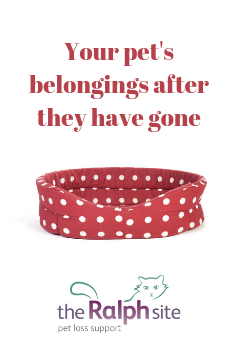
What Happens to Your Pet’s Belongings After They Have Gone?

After a pet dies, we’re faced with the decision about what to do with their belongings. You’re likely to fall in one of three camps. In camp one are the people who throw out, give away or pack up their pet’s belongings immediately. In camp two are the people who can’t bear to move a single thing. Camp three sits somewhere in the middle.

Out of sight, out of mind?

As we’ve said time and again, there is no right or wrong way to grieve.

For some people, coming home to an empty bed, an unruffled blanket, a silent cage, toys that are no longer played with, is too distressing. Every item is a reminder that the animal who loved them is gone.

It’s completely understandable that the people in this camp decide to pack everything away straight away. It isn’t that they want to forget their pet, just that they can’t face the daily reminders of what has been lost.

Some words of caution, if this is your immediate reaction to your loss, is to take a moment to breathe and avoid getting rid of everything while you’re immersed in the first hours and days of grief.

There may be a time, weeks or months from now when you want something tangible to remind you of your lost friend. Many people eventually find comfort from being able to touch a favourite toy, a well-worn collar, a special blanket because of the memories associated with the item.

If it’s too painful to see your pet’s things around the house, could you pack them away for now to be revisited when your pain is less raw?

As though they’re just in another room

In Henry Scott Holland’s poignant poem, Death is nothing at all, the narrator tells us to think of death as though “I have only slipped away to the next room”.

Many pet carers find it unbearable to move their companion’s belongings, preferring instead to keep things as they last were when their friend was alive.

Maybe your house right now feels as though your pet has just slipped away to the next room and may come back at any time.

People often feel that they can’t clear their pet’s belongings away. They worry that it’s a betrayal or that, if the pet knew, they would feel disposable.

In some homes, water bowls remain untouched until the last drop evaporates; favourite blankets stay on the sofa, a collar and lead hang by the door, toys lay waiting in the toy box.

If you sit in this camp, it’s important to remind yourself that grief is a journey rather than a place to stay. Some people find that constantly being surrounded by reminders of their loss keeps it current and taunts the mind with hopes that the parting is temporary.

How would it feel to pack a few things away in a special memory box or donate a few things to someone you know who has a pet who will enjoy them?

Again, there is no right or wrong, only what feels right for you.

What to do with your pet's belongings after they have gone?

When time is against you

We should recognise that one group of pet carers – those with horses – don’t always have a choice about clearing away their loved one’s belongings. It will depend on the livery yard where your horse was stabled and the terms of the contract you have with them.

Some livery yard owners recognise that bereaved horse carers need time to grieve and to decide whether they may want another horse a couple of months down the line. In this case, they may hold the stable for you. Whether you pay full price for this or not will again depend on your arrangement with the yard owner.

Other livery yard owners, especially if they have a waiting list, may not want a stable to sit empty. If you’re not ready for another horse, it’s understandable that the stable owner will want to fill it.

In this situation, you may be faced with packing away your horse’s belongings before you’ve even had time to take stock of your loss.

If this happens, do try to get a loved one to come with you to help with what may be an emotional experience. Perhaps you know someone at the same stables who can hold on to your horse tack for the time being?

A middle ground – keeping your pet’s most precious belongings

Eventually, most people find they sit in camp three when it comes to handling their pet’s belongings.

This usually means keeping some items that have special associations – a dog’s well-worn collar, a cat’s favourite blanket, a rabbit’s snuggle bed, a budgie’s hanging bell toy – but letting others go.

One option is to look out photos or videos of your pet enjoying their belongings. In time, this will be a source of joy and good times remembered.

You could also create a memory box of some of the items that evoke strong memories to be rediscovered for years to come.

There are no rules about what to do with your pet’s things. Whatever camp you fall into, the most important thing is that you’re kind to yourself and that you do what feels right for you.

If you’re struggling with any aspect of pet loss right now, The Ralph Site Facebook group offers a community of people who ‘get it’ and can offer a safe space to talk about your feelings. You can also find details of pet bereavement services on the main Ralph Site.

Until next time,

Shailen and The Ralph Site team
The Ralph Site, non-profit pet loss support

Life after loss: Five ways to honour your pet

After the passing of a loved pet, it can feel like to you’ll stay locked in a place of grief forever. It can be hard to imagine a time when the pain doesn’t consume you. It can also be hard to focus on what your friend gave you when all you can think about is what you have lost.

Thinking about ways we can come through or, perhaps more accurately, live more harmoniously with our grief, the five suggestions below stood out as ways to honour our loved ones.

1.We can honour our memories by living a happy, if different, life

As we’ve said in numerous articles, one of the things that makes animals so special is their capacity for unconditional love and their ability to live in the moment.

Your lost companion would not want you to be unhappy. You gave them a good life, whatever the length of time you had together, and they would want the same for you.

Yes, life will never be the same. It will be different but different can still be happy.

Caring for a pet is a constant reminder that life is too short, so honour the memories you shared by promising to make more happy memories in the future.

2. Grief teaches us to be more compassionate to others

As a vet, compassion has always been important to me but it was when my rescue cat Ralph died that I really connected with the unheard community of people just like me who were suffering the immeasurable loss of a pet. That special cat inspired me to reach out to others and, in doing so, he truly lives on.

A kind word to someone else who is grieving, a smile, a hug, a gentle message of support – these small kindnesses can turn grief into a ripple of goodness that’s felt for years to come.

3. In turn, we can support others more

Following on from point 2, the experience of grief can encourage us to support others more. Within The Ralph Site Facebook group I’m always touched by the number of people who choose to ‘payback’ the support they received at their time of loss by offering the same to new members.

I always think of the animals represented by each person and how the existence of those animals has inspired so much that’s good.

4. We can risk loving a pet even though it will mean another loss

This can be a big, daunting issue for bereaved pet carers – do you have it in you to love another pet knowing you will probably outlive them and have to go through all this grief again?

Some people choose a new companion straight away, some never have a pet again; many fall somewhere in the middle. There is no right or wrong, only what’s right for you.

Personally, I think one of the greatest ways we can honour a pet we’ve lost is to open our hearts to a new companion. It won’t push your old friend out – I find the heart has a way of growing instead.

5. We can grow as a person

There’s a beautiful saying that, “Grief never ends… but it changes. It’s a passage, not a place to stay”. And like many of the life-changing journeys we experience, I think grief gives us an opportunity to grow as a person.

If we can learn to be kinder, more compassionate, more able to love with the risk of loss, then we can grow in so many essential ways. And, above all, that growth is a tribute to the ones we have lost but will always love.

If you’re struggling with any aspect of pet loss right now, The Ralph Site Facebook group offers a community of people who ‘get it’ and can offer a safe space to talk about your feelings. You can also find details of pet bereavement services on the main Ralph Site.

Until next time, Shailen and The Ralph Site team
The Ralph Site, non-profit pet loss support

Grieving the loss of your horse

If you’ve come to The Ralph Site because you’re grieving the loss of a much-loved horse or your horse is nearing the end of their days, then please accept our deepest sympathy and support.

The worst news

According to research by Advancing Equine Scientific Excellence (AESE) only nine percent of horses in the UK die from natural causes. More often, horses pass as the result of a tragic accident or because of an illness or old age leading to a deterioration in their quality of life.

This means that you may be facing or have recently faced the heart-breaking decision to have your companion put to sleep (known as euthanasia). Many animal lovers struggle with the weight and responsibility of this decision.

A friend for all seasons

The death of a horse can be hard to process. After all, a healthy horse can live for 25 to 30 years, which means that your equine companion may have been with you for half of your life or more.

With a lifespan that long, it’s easy to imagine a horse will be by your side forever until the tragic days comes when suddenly they are not there anymore.

Horses often see their carers from childhood into adulthood or watch the seasons of their life unfold – a constant, loving companion through every high and low.

A bond over many years

As you know from experience, a horse is very much a member of your family. You may have spent years together building an unbreakable bond, while investing emotionally, physically and financially in your friend.

For most people who care for a horse, their companion shapes their lifestyle. You may be used to visiting the stable before and after work and spending hours of your leisure time riding and training.

Perhaps you competed with your horse, travelling the country together, or your horse kept you mentally and physically fit.

The chances are that your friends have horses too and that much of your social life revolves around the stables.

Your sense of loss will naturally be deepened by the huge change to your lifestyle that has been caused by your bereavement.

A disenfranchised grief

We talk about disenfranchised grief quite a lot on The Ralph Site because it is something most pet carers have to wrestle with. Unfortunately, our society doesn’t always recognise how devastating the loss of a pet can be, whatever their shape or size.

Many people feel there is some sympathy for people who lose a dog or cat (although this isn’t always borne out experience), but that small animals or larger animals such as ponies or horses pass away unnoticed.

Too often, grieving pet carers hear comments like “It’s only a horse”, “You’re not still upset, are you?” or “You can always get another one”, which can add to the sense of disenfranchisement and, indeed, of isolation and loneliness.

People often feel embarrassed about their grief as a result of societal attitudes – “I should feel better by now” or “I don’t know why I’m so upset” – but, in reality, there is no timeline for feeling better or scale for how upset you should be.

Your horse mattered and your grief matters too. It would be strange to spend years with such a close bond and not feel a massive sense of loss.

Be kind to yourself

However long it’s been since your bereavement, it’s important that you’re kind to yourself. If a friend experienced this loss, what would you say or do to support them? This is the kindness you need to show to yourself.

If the bereavement has just happened, you may be facing tough decisions about where or how to lay your horse to rest. Try to talk through your options – your vet, the stable owners and/or the other horse carers at the stable may be able to offer advice and recommendations.

Another milestone for horse carers is having to pack up a horse’s stable and belongings; if the stable is rented, there may be some urgency to this. It can be tempting to ask a friend to pack everything up on your behalf but many people who have lost a beloved horse say this task actually helped them deal with the grieving process.

If your life extensively revolved around your horse – and what loving horse carer’s doesn’t?! – then you may be waging an internal war about if and when it would be right to get another horse.

People who are passionate about horses often say that being part of the equine community is in their blood. It can be very confusing to know what to do next.

Give yourself time

If you can, try to give yourself time to grieve before you make any decisions. We appreciate that this can be hard for people who compete professionally on the equine circuit but, for most people, there isn’t a deadline on making any decisions about the future.

Try to speak to supportive friends and family about your grief. Have any of your friends at the stables lost a horse before? Perhaps they will be willing to offer you a listening ear.

If you’re finding it hard to talk about your loss, you could keep a diary of your thoughts and feelings or write a letter to your equine companion about your grief or what they meant to you.

Some horse carers find it helpful to volunteer at their local stable or horse rescue centre. This is a positive way of maintaining some of the aspects of the life you enjoyed with your horse while giving you the space to mourn their loss.

If this is too hard for you at the moment, you might get comfort from fundraising for a local horse charity or making a small monthly donation. Some people donate some of their horse’s belongings to a local charity, gaining comfort from knowing that the belongings will be used and enjoyed by another horse.

There’s no right or wrong, only what feels right for you.

Friends at the End

In case you’re not already aware, The British Horse Society has a voluntary service known as ‘Friends at the End’.

If you’re facing decisions about your horse’s end of life care or euthanasia or you’re struggling with an equine bereavement, this service is available for you.

‘Friends at the End’ volunteers are all experienced horse carers who can offer support and advice. It may even be possible to arrange for a volunteer to be with you when your horse passes so that you’re not alone. Some volunteers have held horses in their final moments if their companions don’t feel able to.

Every volunteer has received training in bereavement counselling.

You can find more information about this invaluable service at: http://www.bhs.org.uk/our-work/welfare/our-campaigns/friends-at-the-end

Bereavement counselling and support

If your horse has already passed away, whether it was hours or years ago, support is still available through a variety of sources.

The Blue Cross has a fantastic pet bereavement counselling service – you can call between 8.30am and 8.30pm on 0800 096 6606 if you need to talk to someone (or visit https://www.bluecross.org.uk/pet-bereavement-and-pet-loss for more information).

The Ralph Site is also here to support you. Our private Facebook pet loss support group has an active community of bereaved pet carers who support and encourage one another through the best and worst of times.

Some words of comfort

While writing this blog, we found some beautiful words of comfort for bereaved horse owners. This quote stood out:

"Somewhere...somewhere in
time's own space
There must be some sweet pastured place
Where creeks sing on and tall trees grow
Some Paradise where horses go.
For by the love that guides my pen
I know great horses live again."
- Stanley Harrison

Whatever your beliefs, your horse lives on in the memories you made together. Many pet carers find comfort in this with time.

Until then, know that you’re not alone.

Shailen and The Ralph Site team
The Ralph Site, non-profit pet loss support