Category Archives: Blog

Welcome to our blog!

Each week we will post blog pieces relating to pet bereavement and other animal-related topics. We hope you enjoy the blog and please share your thoughts and comments – we would love to hear from you!

Making The Most Painful Decision Of All

The Most Painful Decision Of All

The Most Painful Decision Of All

As animal lovers, we don’t like to think about the day when we will have to say goodbye to our beloved pets. We hope that when the time does come, it will be a peaceful passing at the end of a long and happy life.

Sadly, as many of us know all too well, sometimes this is not to be. Sometimes our faithful companions become ill or are injured, and we may have to face some very difficult decisions in order to prevent them suffering prolonged pain.

Euthanasia (sometimes referred to as ‘putting to sleep’) describes a deliberate intervention undertaken to end pain or suffering. Discussions with your vet will undoubtedly be emotional; your overriding desire to ‘do the right thing’ will almost certainly be clouded by feelings of guilt, sadness and frustration. If you are currently thinking about ending your pet’s suffering, or indeed when the time comes in the future, you can find some helpful questions and issues to consider HERE. These end-of-life considerations are laid out sensitively yet practically, in order to offer some small reassurance and support as you consider all the options available.

Accepting when is the ‘right’ time can often be the hardest part.

You may find it helpful to consider:

  • Is your pet is still enjoying life? Does he/she seem happy?
  • Is the overall quality of life still acceptable? Think about:
    • Evidence of discomfort
    • Appetite levels
    • Mobility
    • Urinary or faecal incontinence
    • Mental capacity and confusion
    • Ease of breathing – is it a real effort for your pet?
  • What is the prognosis associated with any illnesses diagnosed?
  • Are treatment options available? How aggressive, invasive or uncomfortable are they likely to be?

Ultimately, helping our pets to a dignified and peaceful end is the most important and noble act we can undertake for our faithful companions. However, the decision is particularly painful because in order to end a pet’s suffering, we must unselfishly and lovingly choose to accept our own.

See The Ralph Site for more information on pet loss.

Please note: The Ralph Site is not affiliated with the third-party organisations in any of the links shared here, and the views, ideas and suggestions expressed in this and other blogs are simply shared with the intention of helping you, our friends, take care of the special animals in your lives.

To Neuter Or Not?

As spring starts springing, the number of new puppies and kittens often peaks at this time of year. Not all of these new arrivals will be welcome, which is why The Ralph Site, along with countless animal welfare organisations and charities, highly recommend that you have your pet neutered.

With so many homeless and unwanted pets in the world, and many being euthanised every day, not adding more to this seems the right thing to do. Neutering prevents unplanned, unwanted and ultimately expensive kittens and puppies. It also helps to allow domestic animals to live alongside their human family by reducing aggression, straying, spraying, calling and other anti-social behaviour. There are also some reported health benefits of neutering pets such as prevention of certain types of cancer.

Both spaying and castration are routine and straightforward procedures, and your vet will carry out hundreds of them every year. Both operations are generally done as day cases, so your beloved pet will be home with you the same day for some treats and plenty of TLC.

The British Small Animal Veterinary Association recommends that cats be neutered from four months old, and rabbits and dogs at around six months. Contrary to what you may have heard, there is no requirement to wait until your female dog has had her first season.

It is in everybody’s interests to keep the numbers of unwanted pets as low as possible. Several organisations are able to provide subsidised rates for responsible owners wishing to neuter their pets, and you can find plenty more information about such schemes, as well as a whole host of advice on the following websites:

Some people do believe that neutering causes pets to gain weight. Whilst not strictly true, it does slow down the metabolism of many pets and therefore you may find that your pet is prone to weight gain after neutering. With this in mind, you may wish to consider transitioning your pet onto a food that is designed to provide the correct blend of calories and nutrients for neutered pets. There are a wide selection of brands, flavours and pack sizes available in our shop including Royal Canin and Hills Science Plan Feline.

Please note: The Ralph Site is not affiliated with the third-party organisations in any of the links shared here, and the views, ideas and suggestions expressed in this and other blogs are simply shared with the intention of helping you, our friends, take care of the special animals in your lives.
History Lessons in Feline Appreciation

Cat lovers understand the unique and special qualities of the feline species, valuing their independence and poise. And yet whilst we certainly appreciate these attributes today, the ancient Egyptians went several steps further, revering the species and worshiping the cat goddess Bast; a powerful symbol of protection, fertility and motherhood.

Love of Cats

Scientists believe that cats were first domesticated around 10,000 years ago in the area of the Mediterranean that now forms northern Egypt. First valued for their abilities in vermin control, and respected for their intelligence, by 1,000BC cats had become such an object of veneration that it was common for cats to be mummified after death and buried with food and belongings for their passage to the next life.

History records the discovery in 1888 of 80,000 mummified cats and kittens in tombs in the limestone cliffs at Beni Hassan. Sadly the tombs were soon plundered by locals selling relics and parts to passing travellers, before some quite impressive entrepreneurship took hold. The cats’ linen wrappings were exported to America to be made into paper, whilst the twenty tonnes of cat remains were shipped to Britain to be sold as fertiliser for £4 a tonne. Sadly, not quite the glorious afterlife that might have been imagined by the ancient Egyptians: see HERE.

As sacred beings, cats were afforded special protection under ancient Egyptian law. It was illegal to sell or trade the animals with foreigners, and killing a cat was punishable by death. However, by 390 AD the veneration of cats had declined to such a degree that the Bast religion was officially banned by the state. In modern Egypt, cats are now simply kept as pets, and any religious symbolism has long since evaporated.

And whilst our modern society may not place cats on the pedestals they no doubt feel they deserve, there’s no reason why you can’t kit your own cat out like a queen! We think that this regal red velvet bow collar, for example, would look just the part!

Please note: The Ralph Site is not affiliated with the third-party organisations in any of the links shared here, and the views, ideas and suggestions expressed in this and other blogs are simply shared with the intention of helping you, our friends, take care of the special animals in your lives.

Chipping In!

Estimates suggest that in the UK charities and local authorities have to deal with more than 100,000 lost or stray dogs each year, with a further 30,000 or so stray cats being reported to the RSPCA and Cats Protection. Many are found without any means of identification – even if collars and tags are usually worn, they can easily come off or be deliberately removed.

Microchipping is a quick and easy way to vastly increase the chances of your pet being returned to you should the unthinkable happen and he or she goes missing. It’s also becoming law in many parts of the UK – at present it is compulsory to have dogs microchipped in Northern Ireland and Wales, however from April 2016 it will also become compulsory throughout England.

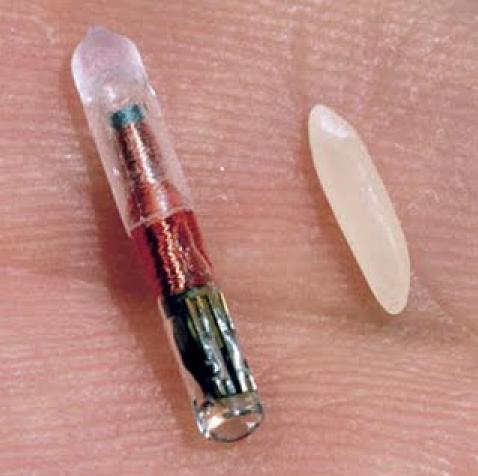
The procedure itself is simple – a tiny chip the size of a grain of rice is inserted under the skin at the back of your pet’s neck. Each chip contains a unique 15-digit reference number that is stored with your contact details in a central database, permanently linking your pet to you.

Pet Id-chips are not much bigger than a grain of rice...and getting smaller all the time!

Pet Id-chips are not much bigger than a grain of rice…and getting smaller all the time!

This does of course mean that it is imperative that you keep any change of address or contact numbers up to date, so don’t forget to register new details when you move house or get a new mobile or email address!

Any lost or stray animals are scanned routinely when they are picked up by vets, charities or local authorities; with one quick phone call you will soon be re-united with your beloved.

And the cost of the procedure itself is relatively low (average prices are around £20-£40 for the initial chip insertion) – we think that this is a small price to pay for the peace of mind that microchipping brings.

You can find more information from the UK’s biggest microchipping service, PetLog.


Microchipping your pets is important

Please note: The Ralph Site is not affiliated with any of the organisations detailed here, and the views, ideas and suggestions expressed in this and other blogs are simply shared with the intention of helping you, our friends, take care of the special animals in your lives.

Pet Loss: When You Need Somebody to Lean On…

Pet loss support

Those of us who have shared our lives with a much-loved animal friend carry the experience with us forever. Just as we can find joy in the memories of happy times shared together, the pain of saying goodbye is also indelibly stamped on our hearts.

Sometimes the visceral pain of our grief is almost too much to bear, and at times like this it can be helpful to speak with someone who understands. You may have sympathetic friends or family who have lost their own pets, and talking over how you feel with them will provide some small comfort.

However, if you feel there is nobody you can share your thoughts and feelings with, at The Ralph Site we want to help.

You can get support from our open public Facebook page; you can ask to join our closed private Facebook group.

For United Kingdom residents, we have also put together a list of experienced Pet Bereavement Counsellors from across the country.
(Please note that whilst we provide details for your convenience, we are unable to directly endorse or recommend these individual services, and you may also wish to research other alternatives to suit your own preferences and requirements.)

In addition, there is plenty of support and advice to be found in the Counselling Directory, the UK’s largest database of registered professional counsellors. Here you’ll find answers to any questions you may have about how counselling works, and which type of approach might be best for you.counselling

Please don’t ever feel that you should be able to cope on your own; there is no need to suffer in silence. Each of us needs someone to share our thoughts and feelings with sometimes, and without acknowledging and expressing the pain we feel we may simply be storing up future problems. As many as 1 in 4 people will experience some kind of diagnosable mental distress during their lifetime, and bereavement is widely acknowledged to be one of the most traumatic times.

Well-meaning friends may tell you that “it’s only a dog” and encourage you to get another one – not everyone understands the deep bond that we form with our pets. You will know when, indeed if, the time is right to bring another animal into your life, and it will never be to replace an old friend, rather to make a new one.