Category Archives: Blog

Welcome to our blog!

Each week we will post blog pieces relating to pet bereavement and other animal-related topics. We hope you enjoy the blog and please share your thoughts and comments – we would love to hear from you!

Toys for education and wellbeing

Providing our pets with mental stimulation is one of the most important things we can do to ensure their continued happiness. Interacting regularly with the animals in our lives has enormous benefits for all, with studies consistently showing a lower level of stress both in pet carers and in the pets themselves. Inevitably there are times in the day when we can’t be with our pets; for these occasions, toys designed to challenge and reward our companions are a valuable addition to their living environments.

Cats

As naturally inquisitive animals, cats enjoy games of chase and catch. Aside from the evergreen balls and other shapes on strings, there are lots of toys on the market designed to stimulate a cat’s natural hunting instincts by chasing ‘prey’ (either a ball or cat treat) around a circuit or through a simple maze. Using an online search engine to look for ‘interactive toys for cats’ will bring up endless options to suit all households and budgets. You can even make something similar yourself by sealing up a cardboard box with a ball or some favourite treats hidden inside and making a few paw-sized holes around the outside.

Toys for education and well being pinterest

Dogs

Almost every dog log lover will know of Kong, maker of the original treat toys. Placing biscuits and treats inside these sturdy chews encourages dogs to work to free their reward, providing exercise and challenge and replicating natural behaviours. The erratic bouncing of the rubber toys and their soft mouth feel make them a great choice, and the wide product range has something for every shape and size of dog.

Rabbits

It’s vital for any animal living in a hutch or cage to have sensory and mental stimulation in order to keep them happy and engaged. There are a wide range of chews, tunnels and boxes available to buy, but the toys you can make at home are just as good (and much cheaper!) Encourage your rabbit to work for his / her food by placing treats inside cardboard tubes or boxes, or inserting them in small holes. Thread leafy greens through the spiral of a slinky toy and hang from the roof of the hutch so that you rabbit has to work to untwist the tasty leaves.
There are plenty more ideas here.

Guinea pigs and small rodents

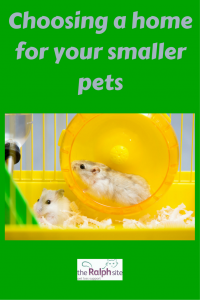
With teeth that continue to grow throughout their life, it’s important that these pets are encouraged to chew often, in order to minimise dental issues. Again, there is a wide range of affordable pet-safe chewing toys available to buy, but variety is important to stimulate your pet’s brain, and so you may wish to add homemade options. The inner tubes of kitchen and toilet rolls are a perennial favourite (especially when stuffed with hay with tasty treats hidden in the centre so your pet has to work to free the treats), but you can also use twigs or small pieces of wood from suitable sources. The Hamster Central forum has a list of safe woods here.
Or for the simplest toy of all, hang a piece of fruit or green vegetable on unbleached twine and hang just within reach!

Ultimately the aim of any toy is to prevent your pet becoming bored, ideally by replicating his / her ‘natural’ pre-domestication environment as best you can. Toys are no substitute for time and attention, but used in addition to lots of together-time they can add variety and mental stimulation to your pet’s daily life without breaking the bank. Making your own toys in itself helps strengthen the bond between you and your pet, and is a great way to keep the children busy too!

Until next time, best wishes from Shailen and The Ralph Site team
The Ralph Site, non-profit pet loss support

Please note: The Ralph Site is not affiliated with the third-party organisations in any of the links shared here, and the views, ideas and suggestions expressed in this and other blogs are simply shared with the intention of helping you, our friends, take care of the special animals in your lives.

Travelling abroad with pets

For many of us, the thought of leaving our pets at home whilst we enjoy a holiday abroad is just too much – after all, what’s the point having a family holiday without a member of the family?! With careful planning it’s perfectly possible to take pets abroad with you in your car, motorhome or caravan (and even by plane, train or ferry) and so this time we’re looking at the practicalities and legalities of holidaying abroad with your pets.

Assistance dogs

It is permissible to take cats and dogs abroad by plane, and all the airlines have specific information on their procedures and requirements online – but do check these well in advance of your trip. Assistance dogs are allowed to travel free of charge with their carers in the cabin (regardless of the class of your ticket).
There’s lots of useful information on how to prepare for your flight, and what to expect, here.

Travelling abroad with pets pinterest

Pet Travel Scheme

Regardless of the mode of transport used, cats, dogs, rabbits, rodents and ferrets returning to the UK must adhere to the requirements of Defra’s Pet Travel Scheme. All the latest details regarding the Pet Travel Scheme can be found here  – the key points are:

  •  The animal must have been microchipped
  • A valid pet passport or third-country official veterinary certificate must be provided
  • All recommended vaccinations must be up to date, and must have been administered at least 21 days prior to travelling
  • The pet must be vaccinated against rabies – he / she will also need a blood test if you’re travelling from an ‘unlisted country’ (the current list of permitted countries can be found online)
  • Dogs must also usually have a tapeworm treatment
  • Your pet may be put into quarantine for up to four months at your own cost if you don’t follow these rules – or he / she may be refused entry if you travelled by sea

If you’d like more detailed advice, you can contact the Pet Travel Scheme helpline on:

  • pettravel@apha.gsi.gov.uk
  • 0370 241 1710 – Monday to Friday, 8am to 6pm (closed on bank holidays)

Practical tips to keep pets happy as they travel

  •  If your pet is a nervous traveller, speak to your veterinary practice in advance of your trip and they will be able to recommend techniques and products that might help, such as pheromone sprays and collars.
  •  On the day of travel do take plenty of water for your pet, and make frequent stops so that he or she can exercise on a lead and take toilet breaks.
  • Pets should always be safely restrained in your vehicle whilst on the move – pets distracting the driver can easily cause accidents, and in the event of any such accident, not only can the animal be hurt, but also the impact of any collision could throw your pet into the other occupants of the car.
  •  Pack plenty of familiar toys and blankets so that your pet can experience the comforting smell of home.
  •  Don’t be tempted to over-do the treats en route – runny tummies are no fun to deal with in a packed car!
  •  To minimise any upset stomachs whilst you’re away, we recommend taking plenty of your pet’s usual food with you. Suddenly switching to a different product is never ideal, least of all in strange surroundings and in (hopefully) hotter temperatures.

And finally – don’t forget to have a fantastic time!

Until next time, best wishes from Shailen and The Ralph Site team
The Ralph Site, non-profit pet loss support 

Please note: The Ralph Site is not affiliated with the third-party organisations in any of the links shared here, and the views, ideas and suggestions expressed in this and other blogs are simply shared with the intention of helping you, our friends, take care of the special animals in your lives.

Top tips for cool pets

We’re a little unaccustomed to hot weather here in the UK, so with the summer holidays almost upon us, we thought it would be good to remind our readers of the importance of keeping your pets cool if the temperature (hopefully!) rises.

Heatstroke can kill
We all know that dogs can die when left alone in hot cars, and yet every year we read more heart-breaking stories. PLEASE never leave your pet alone in a vehicle – in full sun the temperature can rise to deadly levels in a matter of minutes.
If you do see a dog in distress in a parked car, the RSPCA’s advice is to call the Police on 999 (it is a genuine emergency). If the Police are unable to attend, you should call the RSPCA’s 24-hour cruelty line, 0300 1234 999.
You can find more detailed information on this subject here.

Aside from the headlines, there are lots of practical steps you can take to ensure that your pets don’t overheat:

  • Always ensure that your pets can move to a cooler, ventilated environment if you are leaving them at home.
  • Never leave dogs alone in cars, glass conservatories or caravans, even if it’s cloudy.
  • Always provide good supplies of drinking water, in a weighted bowl that can’t be knocked over. Carry water with you on hot days.
  • Groom pets regularly to get rid of excess hair. Give long-coated breeds a haircut at the start of summer.
  • Never allow dogs to exercise excessively in hot weather – walk dogs in the morning or evening – before 8am and after 5pm is best. Not only will this prevent them overheating in the daytime sun, but road surfaces, pavements and sand can burn paws when hot.
  • Dogs can get sunburned – particularly those with light-coloured noses and fur. Ask your vet for pet-safe sunscreen.
  • If you have a small furry pet, such as a hamster or gerbil, put a nearly full plastic bottle of water into your freezer and, when frozen, wrap it in a towel and place by the side of the cage, next to the sleeping area, to keep it cool. It’s not a good idea to put the bottle in the cage as it can cause leaks and make the pet too cold. Putting two in the freezer means you’ll always have one available.
  • Provide plenty of shade whilst rabbits and guinea pigs are in their runs.
  • Fishponds and aquaria can get very hot in the summer – check regularly and make sure the pond has a shaded area where fish can shelter

Top tips for cool pets pinterest

Dogs are particularly susceptible to heatstroke and the condition can be fatal; short-nosed brachycephalic breeds (e.g. Bulldogs, Pugs), longhaired breeds, old and young animals are most at risk. The signs can include any or all of the following:

  • Heavy panting
  • Profuse salivation
  • Rapid pulse
  • Very red gums and tongue
  • Lethargy
  • Lack of coordination
  • Vomiting
  • Diarrhoea
  • Loss of consciousness

If you recognise any of these symptoms in your pet, it’s important to act quickly in order to lower the body temperature gradually, before seeking further advice from a vet:

  • Wet with cool (not cold) water – you could use a shower, or gentle hose spray – and place your pet in the breeze of a fan.
  • Offer small amounts of cool water to drink as long as your dog is conscious and alert enough to drink

Hot sun is not the only potential hazard your pets may encounter over the summer. We recommend that you check your pet regularly for:

  • Grass seeds. These irritants are very sharp at one end, which means that they can easily become embedded in your pet’s skin, causing significant damage. Always remember to check your dog’s paws and ears after summer walks.
  • Harvest mites. The larvae of these mites are tiny (just 0.2mm long) yet these orange/yellow insects can trigger allergies and skin disease in susceptible animals. Contact your vet for further advice if you think your pet is affected.
  • Stings. Inquisitive dogs and cats can easily get more than they bargained for when chasing insects or sniffing in undergrowth, and a sting on the nose is very painful! As you probably know, if a bee stings your pet, the barbed sting will remain in your pet’s skin and must be removed. The best way to do this is by gently scraping it with a flat object such as a bank card (tweezers may squeeze additional venom out of the stinger). Bathe the affected area with a mix of water and bicarbonate of soda and apply an ice pack if your pet will stay still long enough! Wasp stings are not left behind, and because they are alkaline, the area affected should be bathed with vinegar or lemon juice to neutralise the sting, with an ice pack then applied to the area.
  • Snake bites. The adder is the only venomous snake found in the UK – adults are around 60cm long and have brown-black zigzag patterns along their backs, with a V shape on their heads. If you suspect that a snake has bitten your pet, you will see a dark swelling with two puncture marks in the centre – bathe the wound site in cold water to reduce the swelling and contact your vet immediately. Note that bite marks are not always visible. Symptoms of a snake bite can include:
    • Pale gums
    • Bruising
    • Excessive salivation/dribbling
    • Vomiting
    • Diarrhoea
    • Restlessness
    • Drowsiness and lethargy

Of course, with care and common sense any issues your pet encounters can be dealt with quickly and successfully, leaving you and your pet to enjoy the summer while it lasts!

Until next time, best wishes from Shailen and The Ralph Site team
The Ralph Site, non-profit pet loss support

Please note: The Ralph Site is not affiliated with the third-party organisations in any of the links shared here, and the views, ideas and suggestions expressed in this and other blogs are simply shared with the intention of helping you, our friends, take care of the special animals in your lives.

Preparing for loss

We all know that bereavement is just about the biggest stressor any of us will experience in our lives – losing someone we care deeply for is painful and raw, throwing up emotional responses and physical reactions that can’t truly be anticipated. But whilst we can’t know exactly how we’re going to feel, we do know that we will feel differently and with this in mind there are steps that we may be able to take to prepare in some small way for the turmoil ahead.

Many people believe that knowing a bereavement is imminent is somehow ‘better’ than facing it completely out of the blue – certainly there is time to prepare as you try to come to terms with the shift in normality ahead. Of course, any loss is deeply felt and so it’s perhaps more true to say that rather than being ‘better’, knowing in advance of a good friend’s passing simply presents a different set of responses and emotions in the form of ‘anticipatory grief’.

Those of us with pets in our lives may have had to take the decision to end the life of our companion through euthanasia, and knowing that it is the kindest option does not make the decision any easier, or the guilt any less after the event. Not only are we bereft at the loss of a friend, but also their immediate passing is as a direct result of our actions; albeit actions taken, and decisions made, with love and compassion. Of course, our rational logical brains know that euthanasia really is the right choice, but our fragile hearts may feel the burden of one or all of the seven stages of grief at different times: shock or disbelief, denial, bargaining, guilt, anger, depression, and acceptance / hope.

Self-help books, online resources and bereavement counsellors can all provide support and advice in advance of a traumatic event, and speaking with friends and family who may have undergone similar experiences is always beneficial. Psychologists advise that a child’s stress levels are at their highest of any point during the bereavement process just before the death of a loved one, and therefore it’s particularly important to help children prepare as best they can for this difficult time with additional love, time and space. The death of a pet is often the first time a child may have experienced loss, and of course the bond between a child and his / her pet is particularly strong. If this is an area that applies to you and your family, you might like to explore the online resources available from the Childhood Bereavement Network.

Preparing for loss pinterest

There is lots of practical information on preparing for and coping with bereavement available on the NHS website as well here.

But it seems appropriate to leave the last word to the great philosopher of our time, Winnie the Pooh, who received these wise words from his good friend Christopher Robin on the subject of love and loss:

“If ever there is tomorrow when we’re not together… there is something you must always remember. You are braver than you believe, stronger than you seem, and smarter than you think. But the most important thing is, even if we’re apart… I’ll always be with you.”
(‘The House at Pooh Corner’, A.A. Milne)

Until next time, best wishes from Shailen and The Ralph Site team
The Ralph Site, non-profit pet loss support

Public Facebookpage
Private Facebook group

Please note: The Ralph Site is not affiliated with the third-party organisations in any of the links shared here, and the views, ideas and suggestions expressed in this and other blogs are simply shared with the intention of helping you, our friends, take care of the special animals in your lives.

Rabbit Awareness Week

Those of you with rabbits will no doubt already know that Saturday June 18th marked the start of Rabbit Awareness Week – an annual focus that runs until June 26th, covering all things leporine. Rabbit Awareness Week was established ten years ago by coalition of experts, organisations and welfare charities from the rabbit community, to educate old and young alike on the best ways to provide domesticated rabbits with happiness and health. You can find out more about the many aspects of RAW’s work here.

To mark the occasion, hundreds of vets, rescue centres and pet stores across the UK are holding special events; ranging from free health checks to food sampling and rabbit education workshops. 602 events across the UK have been registered on RAW’s website for 2016, so why not take a look at what’s happening near where you live here.

The RAW focus for this year is ‘#BuddiesforBunnies’ – just like us humans, rabbits are naturally social animals, which means that companionship is crucial for their wellbeing. Unfortunately, research finds that in stark contrast to this, 57% of the UK’s pet rabbits live alone. RAW 2016 aims to inspire pet carers to take on a suitable friend for their single rabbit by encouraging them to re-home a rabbit from a local welfare centre.

And there are certainly plenty of rabbits waiting for a new forever home – sadly over 67,000 rabbits are given up for adoption in the UK every year. So if your rabbit currently lives alone, please do consider finding him or her a new friend – not only will you improve your pet’s life, but you’ll be able to bring companionship to a local bunny who is currently housed with a rescue charity or welfare organisation – everybody wins!

Rabbit awareness week pinterest
There are some important things to remember when introducing a new rabbit to your current pet, and the RSPCA has an excellent factsheet  on the topic:

  •  Provided both animals are neutered, a male and a female will live together quite happily. Single-sex pairings are also common
  • As prey animals, rabbits are naturally cautious and territorial, and so the two animals should meet in a neutral environment for the first time – not in your current pet’s hutch or run for example
  • Ideally, choose a large space with plenty of distractions (food, toys, hiding places)
  •  Introduce the two animals into the meeting area at the same time. The rabbits may ignore each other initially, or may watch carefully from a safe distance. If they begin to fight, separate the two and try again the next day. Keep persevering until the two rabbits bond
  • At this stage it helps to position the two separate hutches facing each other so that the rabbits can get used to each other when they are not yet living in the same space
  •  Once the pair sit together and groom each other, you’ll know that they have successfully bonded. In almost all cases they will remain friends for life!

Aside from the #BuddiesforBunnies campaign, RAW also works to educate those with rabbits in their lives on the optimum conditions for pet rabbits. You can find lots of advice on diet, housing, behaviour and health issues on RAW’s website, as well as here.

Until next time, best wishes from Shailen and The Ralph Site team
The Ralph Site, non-profit pet loss support 

Please note: The Ralph Site is not affiliated with the third-party organisations in any of the links shared here, and the views, ideas and suggestions expressed in this and other blogs are simply shared with the intention of helping you, our friends, take care of the special animals in your lives.