Monthly Archives: May 2016

Animals in the news

As true animal lovers know, respecting the natural instincts and needs of animals is an essential basis for enjoying a positive relationship that benefits both human and animal. In this light, research published this week highlighting the number of wild animals living in UK properties makes for uncomfortable reading.

Following a freedom of information request to every council in the UK by the Press Association, a clearer picture has emerged of the numbers of wild animals being kept privately, outside those housed by zoos and welfare organisations:

  • More than 100 councils have issued licenses for predatory animals
  •  Big cats are being kept in several locations; with thirteen tigers, two lions, eight leopards, seven cheetahs and nine pumas all legally registered
  • Fifteen wolves are registered to addresses in the UK
  • Over 300 cobras, vipers and rattlesnakes are licensed
  •  Ten alligators, nine crocodiles and seventeen caimans are living in approved domestic residences
  • 412 bison and more than 2,000 wild boar are living in private fields around the UK, whilst the research also highlights a small zebra population
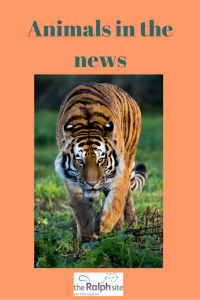
Animals in the news pinterest
Dangerous Wild Animals (DWA) licences are granted to allow UK residents to keep undomesticated animals as pets, providing they follow a series of safety measures and pay a small fee. Not surprisingly, the RSPCA has voiced its concerns about the findings:

“We are deeply concerned about the number of exotic animals, including dangerous wild animals, now being kept as pets. People may buy them with little idea of how difficult they can be to keep and the animals are sometimes neglected when the novelty wears off and the commitment hits home. This is why we would encourage anyone thinking of getting an exotic pet to find out as much as possible about the animal’s needs and whether they are a realistic pet.
Licences for exotic animals classed as dangerous wild animals are granted by local authorities and the details are also held locally. There is no centrally held list to determine how many are kept across the country. The emphasis of this legislation is on making sure the owner takes reasonable steps to prevent the animal from being a threat to the public, rather than the welfare of the animals concerned.”
Above is from Sky News.
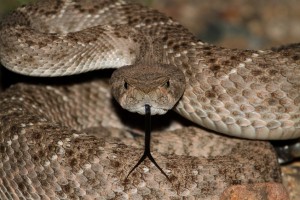
Western Diamondback Rattlesnake (Crotalus atrox) coiled to strike

A happier news story reported in recent days concerns Eddie, the Yorkshire terrier from Stockport who, after going missing for five years, has now been reunited with his owners following a routine veterinary check-up. Eddie was being looked after by relatives whilst the Wright family were away on holiday, but when he escaped from the garden an extensive local search failed to find him and the devastated family thought they had lost him forever. It seems that Eddie was taken in by a lady in the area who cared for him in the intervening period, until very recently she became unable to care for him and Eddie went to live with a neighbour. Now aged thirteen, Eddie was taken to the vet for a routine check-up by his new care, where a microchip check registered him as missing. The Wright family had kept their contact details up to date with the microchip database and so they were soon contacted with the good news.

Sandra Wright told reporters: “Best of all, he arrived home on my daughter’s 16th birthday. I printed off one of Eddie’s ‘missing’ posters from the computer for when she arrived home from school, then when she came in and saw Eddie next to it she was over the moon and said it was the best birthday present ever!”
Above is from the Guardian online.

We do love a story with a happy ending! And it just goes to show how important it is both to microchip your pets and also to keep your contact details up-to-date in case the unthinkable should happen.

Until next time, best wishes from Shailen and The Ralph Site team
The Ralph Site, non-profit pet loss support 

Please note: The Ralph Site is not affiliated with the third-party organisations in any of the links shared here, and the views, ideas and suggestions expressed in this and other blogs are simply shared with the intention of helping you, our friends, take care of the special animals in your lives.
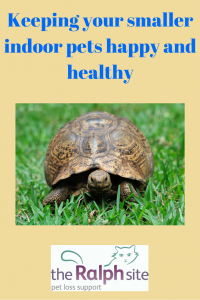

Keeping your smaller indoor pets happy and healthy – Part 2

Those of you who care for more unusual pets will know that providing a suitably stimulating and safe living environment is essential for their health and well-being, and just as important as offering the right diet. This week we take a look at some of the key considerations when caring for reptiles and amphibians, for those of you who may be at the beginning of your friendship with an indoor pet. Of course, the introductory information included here is necessarily basic – we always recommend researching the needs of your pets fully before you welcome them home, along with speaking with the re-homing centre in order to ensure that you’re comfortable with the level of responsibility required and can accommodate the established routine of your new pet.

This week we take a look at the basic needs of some popular reptiles and amphibians:

Lizards

Leopard Geckos are perhaps the most suitable lizards for anyone new to lizards and exotic pets – they are small, easy to handle and do not require specialist UV lighting in their tanks as they are nocturnal creatures. Bearded dragons are also popular in the UK as they generally have a docile temperament, although their housing requirements can be more complex due to their larger size and need for UV lighting.

Welcoming a lizard into your life requires commitment – as with any pet it’s important to make sure that you understand the responsibilities and time involved in providing a full and happy life for your pet. Some basic considerations might include:

  • Check the adult size of your pet and choose a suitably large tank
  • Is there a local vet who specialises in the care of exotics?
  • Remember that geckos can live for 20 years
  • Geckos can be housed in groups of two or three, but there should only be one male per tank (and obviously housing females with a male will inevitably lead to baby geckos!)
  • As insectivores, geckos require a steady supply of insects in order to remain healthy

Snakes

Like any animal, snakes have their own individual temperaments and personalities, and so the relationship you develop with him / her will be truly unique. Popular species here in the UK include corn snakes and Royal Pythons. Caring for snakes is very rewarding but we would always recommend thoroughly researching the requirements of your chosen species in order to make sure that the tank and diet you provide are appropriate.

  • Feeding snakes is not for the squeamish – you’ll need to provide a ready supply of mice pinkies, smaller than 1.5 times your snake’s girth.
  • Snakes can live for 10-20 years.
  • Handling should be limited to 10-15 minutes at a time in order to prevent the snake’s core temperature dropping.
  • All reptiles, snakes included, require a thermogradient in their living environment. In practice this means placing a guarded heat lamp at one end of your pet’s vivarium, with the opposite end left cool. The ‘basking zone’ temperature should be 28-30 oC, and the cool end 20-24 oC.
  • A humidity of 40-50% is also required in order to prevent your snake developing breathing problems and skin problems.


kEEPING YOUR SMALLER INDOOR PETS HAPPY AND HEALTHY part 2 pinterest


Tortoises

As with all pets, it’s important that your tortoise comes from a reputable home – please consider re-homing animals in need of a forever home as a first choice. We do not recommend pet shops or garden centres for finding a pet tortoise, instead details of reputable UK breeders who are passionate about these amazing pets and who follow strict welfare codes can be found at here.

  • Happy tortoises are famously long-lived, so it’s important to consider future plans for your pet.
  • Tortoises need a diet high in fibre, vitamins and minerals, but low in fat and proteins – they feed mainly on green leaves such as charlock, chickweed, clover, dandelion and groundsel. Salad and green vegetables should be fed raw and in moderation. Please be aware that ragwort is toxic for tortoises.
  • If you also share your home with a dog, great care must be taken to ensure that your tortoise has a safe and secure enclosure that the dog cannot enter.
  • Tortoises are not native to the UK and thus require daily access to heat and light in order to stay healthy and happy. Your indoor enclosure should feature a specially-designed UVB light and heat lamp.
  • Winter hibernation is a normal part of a healthy tortoise’s life, and it’s important to prepare your pet properly. The topic is covered in far more detail here.

Of course we have only been able to cover a very small introduction here to the complex care requirements of these exotic animals. Please always research thoroughly and consider carefully the particular needs of your pet before making the commitment to his / her care; this is especially important for exotic animals such as lizards, snakes or tortoises.

Until next time, best wishes from Shailen and The Ralph Site team

The Ralph Site, non-profit pet loss support 

Please note that The Ralph Site very strongly encourages people to only bring new companion animals into their home that they have rehomed from a rescue centre or that are otherwise unwanted or being subjected to mistreatment; with so much over-supply of unwanted animals, we cannot condone private breeding or indeed removing non-domesticated animals from their natural outdoor environment to be kept as pets.

Keeping your smaller indoor pets happy and healthy – Part 1

Please note that The Ralph Site very strongly encourages people to only bring new companion animals into their home that they have re-homed from a rescue centre or that are otherwise unwanted or being subjected to mistreatment; with so much over-supply of unwanted animals, we cannot condone private breeding or indeed removing non-domesticated animals from their natural outdoor environment to be kept as pets.

According to the latest set of UK figures published by the Pet Food Manufacturers Association (PFMA), 46% of British households share their homes with a pet. And whilst cats and dogs are our nation’s most popular companions, considerable numbers of us have plenty of love to give our smaller furred, feathered and scaled friends:

  • The indoor fish population is estimated at a massive 19,900,000, living in around 9% of UK homes
  • There are 500,000 indoor birds
  • 400,000 hamsters
  • 300,000 lizards
  • 300,000 snakes
  • 200,000 tortoises and turtles

Those of you who care for these smaller indoor pets will know that providing a suitably stimulating and safe living environment is essential for their health and well being, and just as important as offering the right diet. We thought it might be helpful to look at some of the key considerations when looking after smaller pets, for those of you who may be at the beginning of your friendship with an indoor pet. Of course, the introductory information included here is necessarily basic – we always recommend researching the needs of your pets fully before you welcome them home, along with speaking with the re-homing centre in order to ensure that you’re comfortable with the level of responsibility required and can accommodate the established routine of your new pet.

This week we take a look at the basic needs of birds and hamsters:

Birds

  • Budgies and canaries can live up to 15 years, with large parrots clocking up as many as 60 years
  • Birds flourish with lots of time and attention and will create strong bonds with their carer, developing their own unique personality traits. They also pick up on your mood and can become depressed if not given sufficient attention, becoming prone to stress-related conditions such as pulling out feathers
  • Most birds enjoy company from their own kind, so it’s always best to provide an avian friend
  • Good quality birdseed forms the basis of a domestic bird’s diet and is widely available -depending on your pet’s species, additional supplements are often recommended (such as iodine for budgies)
  • Buy the largest cage you can afford and make sure it’s appropriate for your bird’s adult size. Furnish it with plenty of toys and perches, as well as a birdbath, and use bird-friendly cleaning products to keep the cage fresh. Always give your pet the opportunity to spread his / her wings for lengthy periods each day
  • Make sure to cover any mirrors and windows when your bird is exercising out of the cage each day – flying into these can injure your pet severely

Keeping your smaller indoor pets happy and healthy pinterest

Hamsters

  • Typically hamsters live for up to 2 years. As nocturnal animals, they are the ideal pet for anyone who works a ‘normal’ week, as they will sleep whilst you’re out during the day
  • The most popular species in the UK are Syrians, the Russian dwarf Campbell and the Roborovski
  • Hamsters need lots of room so buy a cage that’s as large as possible. Multi-levels and tunnels are great for exercise and exploration, and cages with wire sides and tops will provide your hamster with plenty of climbing opportunities! A wheel will provide endless fun, and cardboard tubes and wooden chewing blocks will help keep your pet’s teeth in check, as well as providing stimulation.
  • Although hamster balls are popular and offering animals the opportunity to exercise is important, there are concerns that such products may, in fact, be stressful for hamsters and the RSPCA for example does not recommend their use.
  • Provide plenty of bedding and litter material for your hamster to burrow in and make his / her bed from. Dust-free wood shavings and shredded paper are great options
  • As with all pets, your hamster will need access to a continual supply of fresh water.
  • Commercially produced hamster food is the best diet, supplemented with small quantities of green vegetables and apples. Avoid grapes and rhubarb as these can be poisonous for hamsters.
  • Hamsters are generally solitary animals with their own kind but are sociable with us humans, so it will be easy to get into a routine of handling your pet every day to form strong bonds.

Next week we’ll look at keeping rescued reptiles and amphibians, so until then, best wishes from Shailen and The Ralph Site team

The Ralph Site, non-profit pet loss support

Please note: The Ralph Site is not affiliated with the third-party organisations in any of the links shared here, and the views, ideas and suggestions expressed in this and other blogs are simply shared with the intention of helping you, our friends, take care of the special animals in your lives.
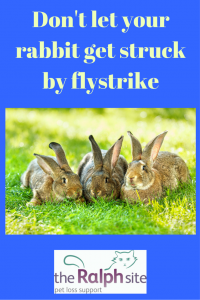
Don’t let your rabbit get struck by flystrike

Just when it seems like we might finally be able to enjoy some sunshine and warmer weather, along comes another reminder that increasing temperatures can bring increased risks for your pets! Sorry about that!

Those of you with rabbits in your lives will probably already know about flystrike – a painful and potentially fatal condition spread by the bluebottle flies that are more active in the warmer months. Attracted by the scent of urine or faeces, the fly will lay its eggs on a rabbit’s skin. Unless removed by careful grooming, these eggs hatch into maggots that begin to eat the poor animal’s flesh. Horrible as this is to contemplate, the condition can escalate very quickly, and sadly many rabbits with flystrike die.

Dont let your rabbit get struck by flystrike pinterest

Rabbits who are unable to clean themselves effectively are particularly at risk – for example elderly, injured or sick pets – as are those kept in hutches and runs that are not regularly cleaned. Otherwise healthy rabbits suffering from temporarily loose stools are also vulnerable.

If you ever find any visible maggots on your pet, remove these with tweezers and take the rabbit to see a vet immediately – this is a genuine emergency situation as affected rabbits will not only be in great pain from their wounds, but can also be in danger of experiencing toxic shock.

Fortunately there are some simple steps you can take in order to greatly reduce the risk of your beloved rabbit suffering with flystrike:

  • Regular grooming is essential, removing any matted fur or faecal matter from around the bottom.
  • Removing soiled bedding and litter daily, and giving the hutch and run a thorough clean at least once a week.
  • Checking your rabbit daily for sores – the condition takes hold very quickly.
  • Applying an animal-safe spray or powder designed to repel flies – Rearguard is a popular choice for rabbits, and your vet can also offer specific advice that’s tailored to your pet.
  • Planting rabbit-safe flowers and herbs known to repel flies close to the hutch (suitable varieties are listed in the flystrike information section of the Rabbit Welfare Society’s website.
  • Placing fly paper or insectocutors above your rabbit’s hutch, safely out of harm’s way.

However, the bottom line (excuse the pun!) is that it’s simply not possible to eliminate all risk from flystrike. Outdoor rabbits will be exposed to flies all year round, although the problem is known to be more commonplace in the summer. Vigilance is by far your best weapon against this horrible condition, and it’s never a hardship to spend time bonding with your bunny as you give him/her a good grooming and a thorough checking over.

Until next time, best wishes from Shailen and The Ralph Site team,
The Ralph Site, non-profit pet loss support

Please note: The Ralph Site is not affiliated with the third-party organisations in any of the links shared here, and the views, ideas and suggestions expressed in this and other blogs are simply shared with the intention of helping you, our friends, take care of the special animals in your lives.